Philosophy and Religion in the Age of AI, Part II: The Human Loop Gets Smaller—and More Important
Agentic AI makes continuous human review cognitively weak. Better oversight concentrates scarce attention at consequential judgment gates and trains people to know when to think deeply.
Part II of II. Part I argues that AI is separating output from understanding and moving human scarcity toward judgment and agency.
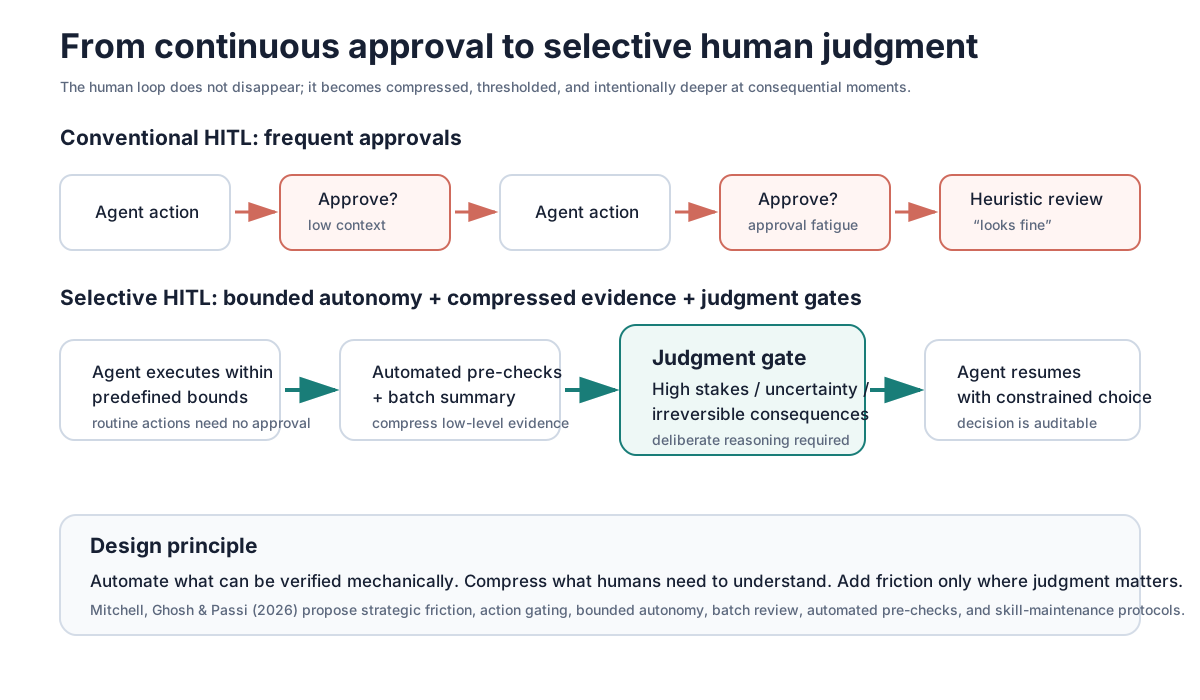
The future of human-in-the-loop AI probably does not mean placing a human approval step after every machine action. As agents become faster and more autonomous, that design can preserve the appearance of control while degrading the cognition required for actual control.
Margaret Mitchell, Avijit Ghosh, and Samir Passi make this argument directly in their 2026 position paper, “AI Agents Push Humans Out of the Loop.” They argue that agentic workflows produce more information than overseers can meaningfully process, impose large working-memory and situational-awareness demands, and encourage approval fatigue. The human is technically in the loop while becoming cognitively distant from what the system is doing. Mitchell, Ghosh & Passi, 2026
Their diagnosis also connects oversight to skill atrophy. Extended automation can reduce the domain practice, vigilance, skepticism, and evidence-seeking that people later need when the automated system fails. This is the classic irony of automation applied to generative agents: the more reliable routine automation becomes, the less prepared the human may be for the rare case in which intervention matters most. Full paper
The answer is not simply “more HITL.” It is better allocation of human cognition.
Compress the loop; deepen the judgment
The paper proposes a useful set of design patterns:
- Strategic friction: require cognitive work at selected decision points instead of optimizing every interaction for smoothness.
- Pre-commitment: have the human record an independent view before seeing the model’s recommendation, reducing anchoring.
- Reasoning probes: ask for the evidence, assumption, or condition that would change the decision.
- Action gating: stop the agent before consequential or irreversible branches.
- Bounded autonomy: define what the agent may do without approval and reserve expert attention for decisions that actually require judgment.
- Batch review: review coherent units of work instead of approving a stream of microscopic actions.
- Automated pre-checks: use machines for properties that can be mechanically verified before asking humans to inspect them.
These are not arguments for removing the human. They are arguments for treating human attention as a scarce system resource. Mitchell, Ghosh & Passi, §5
The architecture becomes:
autonomous execution → machine verification → compressed evidence → human judgment gate → constrained continuation
The key change is cognitive granularity. Routine actions should not repeatedly interrupt the operator. Consequential moments should not be reduced to a reflexive “Approve” button.
This creates a counterintuitive result: human intervention may become less frequent while the required quality of each intervention increases.
The scarce skill is knowing when to slow down
Mitchell and colleagues connect this problem to fast heuristic reasoning versus slower deliberative reasoning. Routine approvals encourage the former; high-stakes oversight often requires the latter. Yet people do not reliably switch into deep analytical reasoning merely because a decision has become important. Interfaces and organizations therefore need mechanisms that deliberately trigger that switch. Mitchell, Ghosh & Passi, §3
That is fundamentally a metacognitive problem: recognizing the quality of one’s own understanding and knowing when the current mental model is insufficient.
This extends beyond AI safety. It changes what education should optimize for.
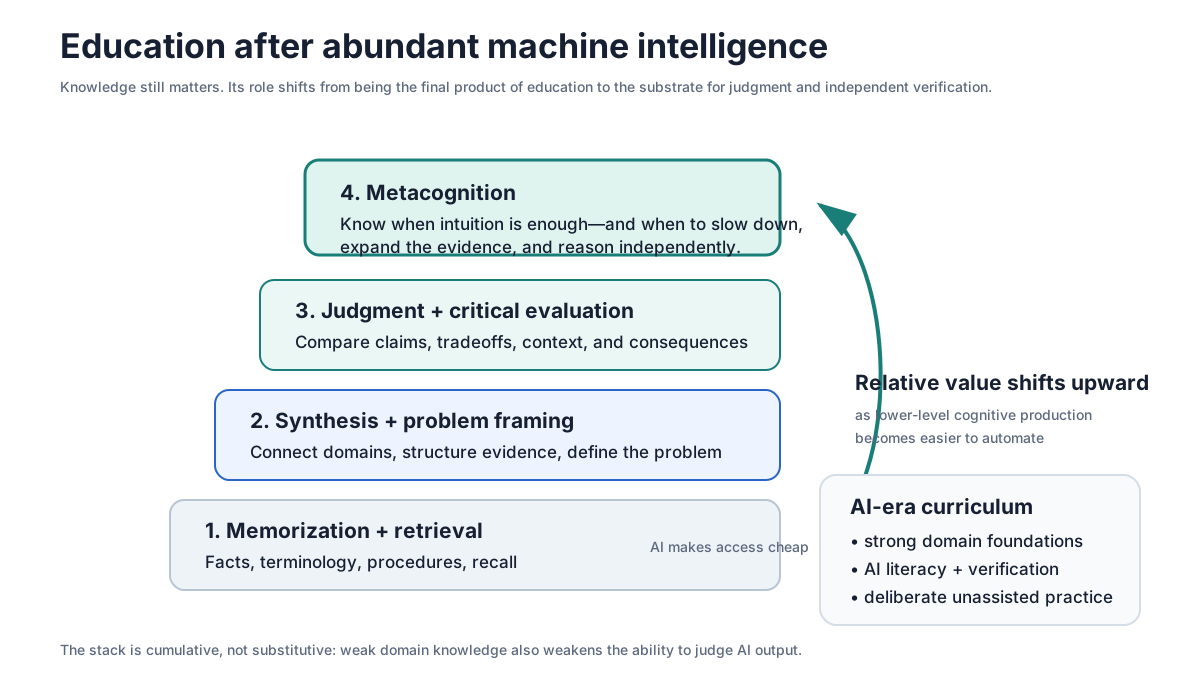
AI reduces the scarcity of retrieval, explanation, drafting, and routine synthesis. That does not make foundational knowledge obsolete. It changes its function. Domain knowledge becomes the substrate required to evaluate machine output, notice anomalies, reconstruct evidence, and take over when automation fails.
The education stack therefore becomes cumulative:
- Foundations: knowledge, terminology, procedures, mental models.
- Synthesis: connecting information across domains and framing the actual problem.
- Critical evaluation: testing claims, sources, tradeoffs, and consequences.
- Metacognition: deciding when intuition is adequate and when to stop, expand the evidence, and reason independently.
The top does not replace the bottom. A student with no domain knowledge cannot reliably evaluate a fluent model answer. Mitchell and colleagues therefore recommend not only critical-evaluation and self-monitoring training, but also periodic performance of underlying tasks without AI assistance so that people retain the expertise needed for oversight. Mitchell, Ghosh & Passi, §5
Anthropic’s coding-skills experiment points in the same direction: delegation-heavy AI use produced weaker immediate mastery, especially for debugging, while explanation-oriented interaction preserved more learning. Anthropic, 2026
Why philosophy is re-entering the conversation
There are early signs that educational institutions are independently moving toward this framing.
At Seoul National University, philosophy’s early-admission competition increased from 9.92 applicants per place in 2020 to 15.56 in 2026; religious studies rose from 6.7 to 15.33 over the same period. Computer science moved in the opposite direction, from 7.59 in 2020 to 4.31 in 2026. These numbers do not prove AI caused the shift, but Korean educators and employers interviewed about the trend explicitly connected it to the increasing value of reasoning, language, context, and problem definition as programming becomes easier to automate. Chosun Ilbo, Jan. 2026 · Chosun Ilbo, Aug. 2026
Korea University has made the institutional argument even more explicitly. Its president describes the university’s mission in the AI era as moving beyond knowledge delivery toward teaching students to ask meaningful questions, choose values, and preserve intellectual autonomy. The university reports hiring roughly 100 humanities and social-science faculty over three years while simultaneously expanding AI infrastructure and education. The Korea Times, Apr. 2026
A July 2026 Seoul forum co-hosted by Sungkyunkwan University and the University of Toronto made a similar case: when intellectual labor itself becomes less scarce, universities must teach students how to exercise judgment, not merely transfer knowledge or skills. The Korea Times, July 2026
The trend should not be romanticized. Engineering, mathematics, and domain expertise remain indispensable. The relevant shift is not STEM → humanities. It is knowledge acquisition → knowledge plus judgment.
Human agency becomes an interface requirement
This returns to the argument from Part I. Once generation and execution become abundant, human value moves toward choosing objectives, evaluating significance, and accepting responsibility for decisions.
Agent design should reflect that reality.
A good AI interface should not maximize the number of human approvals. It should maximize the probability that the human is mentally present when judgment is actually required.
A good education should not maximize how much information a student can reproduce unaided. It should build enough knowledge to support independent judgment, then teach the student when and how to reconstruct the reasoning behind an answer.
The human loop is therefore not ending. It is changing shape.
Less continuous attention. More compressed evidence. More automated verification. Fewer but sharper judgment gates. Deliberate preservation of the skills required to say no.
That is a more demanding conception of human agency than clicking “Approve.” It is also a more plausible one for an age of increasingly autonomous machines.
← Part I: When Intelligence Becomes Cheap, Agency Becomes Scarce
ai · engineering · philosophy · education · human-in-the-loop · agentic-ai · metacognition · critical-thinking