Philosophy and Religion in the Age of AI, Part I: When Intelligence Becomes Cheap, Agency Becomes Scarce
Coding agents are separating output from understanding. The durable human advantage may be less about generating answers than choosing objectives, judging significance, and preserving agency.
Part I of II. Part II examines how human oversight and education should change when agentic AI makes continuous review impossible.
A recent technical book-club discussion started with something closer to grief than skepticism about AI. A software engineer described building more with coding agents while understanding less of what he had built. His home lab worked. His code shipped. But when he wanted to change a behavior, he increasingly had to ask the agent where the change belonged.
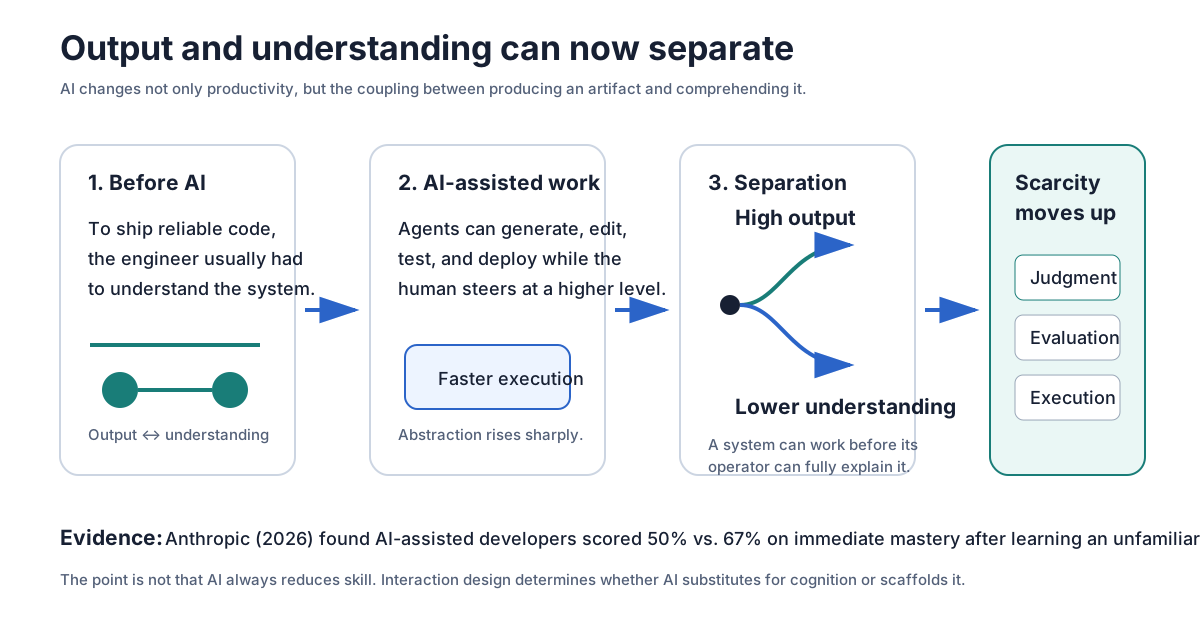
That experience points to a structural change in knowledge work: AI can decouple production from understanding.
Anthropic tested a narrow version of this problem in a 2026 randomized study of 52 software developers learning an unfamiliar Python library. AI-assisted participants finished only about two minutes faster, a difference that was not statistically significant, but scored 50% on an immediate mastery test versus 67% for the hand-coding group. The largest deficit appeared in debugging. Importantly, interaction style mattered: developers who used AI for conceptual explanation learned more than those who delegated implementation wholesale. Anthropic, 2026
The broader evidence is not simply “AI makes programmers worse.” Productivity varies by task. METR’s 2025 randomized trial found experienced open-source developers working in repositories they knew well took 19% longer with early-2025 AI tools, even though they believed AI had accelerated them. METR’s 2026 follow-up says newer tools probably provide more speedup, but selection effects make the magnitude difficult to estimate. METR, 2025 · METR, 2026
The durable point is different: output, understanding, perceived competence, and actual competence can now move independently.
Microsoft Research and Carnegie Mellon found a similar shift among 319 knowledge workers reporting 936 real-world uses of generative AI. Higher confidence in AI was associated with less reported critical-thinking effort. Critical thinking did not disappear; it shifted toward verification, response integration, and what the researchers call task stewardship. Lee et al., CHI 2025
The scarce layer moves upward
Software engineering has always used abstraction. A programmer does not need to understand transistor physics to use a database. Coding agents are different mainly in degree: the abstraction can now perform a growing share of the construction itself.
That changes where expertise compounds.
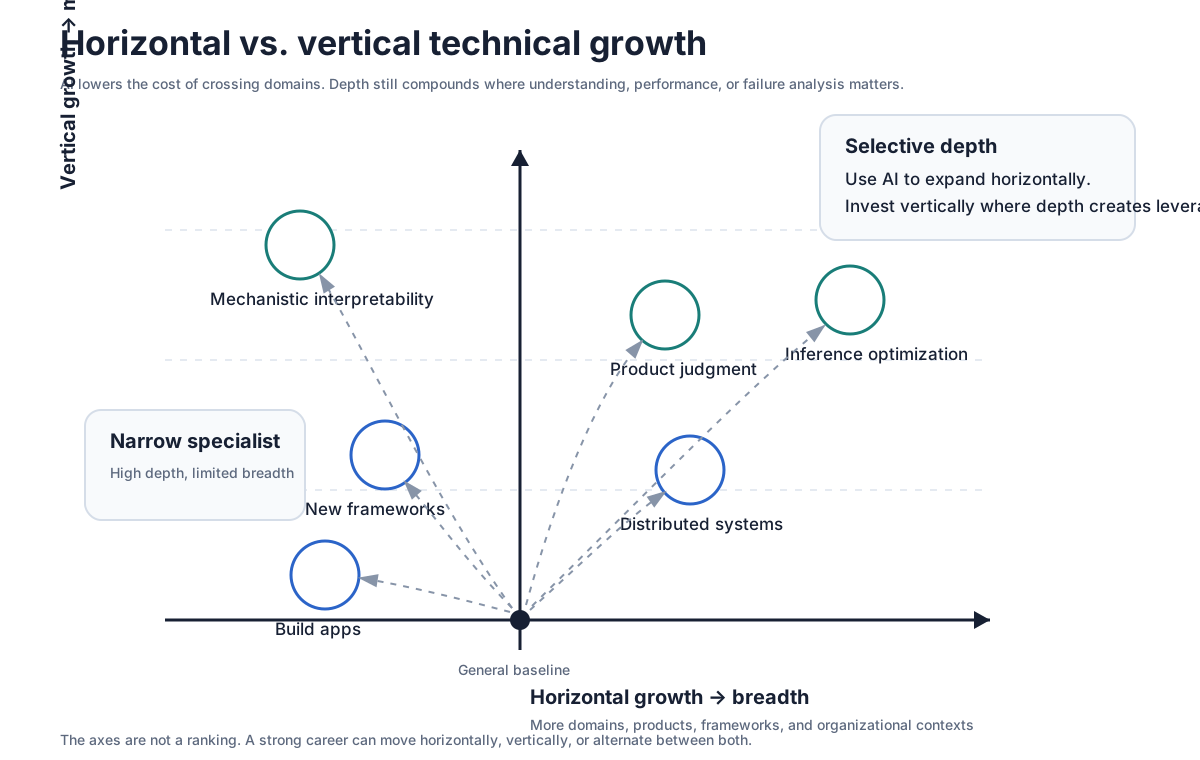
AI makes horizontal growth cheaper. One person can cross more quickly into infrastructure, data, ML, UI, product, security, and unfamiliar frameworks. That breadth is real learning. It produces stronger systems intuition and makes previously impractical projects accessible.
But horizontal expansion is not the same as vertical mastery. Deep competence still matters where failure is expensive, performance differentiates the system, abstractions leak, or the human must diagnose something the model cannot reliably repair. The practical response is not to preserve every manual skill. It is selective depth: delegate commodity execution while deliberately retaining mastery in the domains where understanding creates leverage.
Creativity is the wrong boundary
A tempting defense of human uniqueness is that language models merely imitate while humans create. The evidence is already too complicated for that claim.
In a 2024 Scientific Reports study comparing 151 people with GPT-4 on standard divergent-thinking tasks, GPT-4 produced responses that scored higher on originality and elaboration. The authors are careful about the interpretation: divergent thinking measures creative potential, not usefulness, appropriateness, or real-world creative achievement. Hubert, Awa & Zabelina, 2024
A better distinction is generation versus valuation.
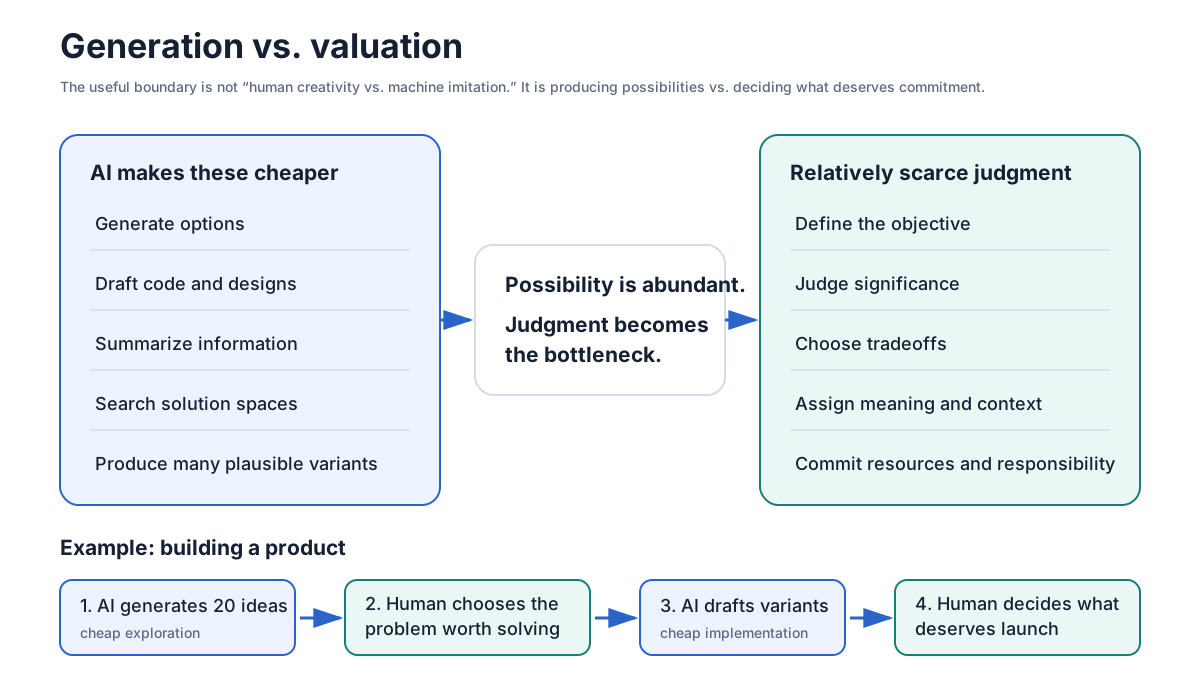
Generating possibilities is becoming cheap: candidate architectures, product concepts, designs, explanations, experiments, and code variants. The harder problem is deciding which possibility is significant, which constraint should dominate, which tradeoff is acceptable, and which objective deserves optimization at all.
This is where engineering begins to touch philosophy.
The Stanford Encyclopedia of Philosophy defines practical reason as the capacity to resolve through reflection what one is to do. It is not merely prediction or means-end optimization; it evaluates alternatives in light of reasons and values. Stanford Encyclopedia of Philosophy, “Practical Reason”
An AI system can search an objective landscape extraordinarily well while leaving a prior question unanswered: why this objective? Latency versus accuracy, engagement versus well-being, autonomy versus safety, profit versus access—these are not produced by optimization alone. They encode priorities.
Why religion belongs in the discussion
Philosophy contributes concepts such as agency, reasons, responsibility, knowledge, and value. Religion adds another category: telos—what human activity is ultimately for.
That question becomes more concrete as machines perform more intellectual work. If human significance depends primarily on being the most cognitively capable entity in the room, increasingly capable AI is destabilizing. But theological anthropology has never reduced humanity cleanly to raw intelligence. It has debated personhood through rationality, relationship, moral responsibility, embodiment, vocation, creation, and the imago Dei.
The 2026 Oxford Handbook of Digital Theology explicitly treats AI as a challenge for theological anthropology and human self-understanding. Its chapter on AI argues that nonhuman intelligent agents force renewed examination of intelligence, ethics, creation, human distinctiveness, and relational life. Oxford University Press, 2026
Religion does not provide an implementation recipe for an agent architecture. Its contribution is at another layer: it has spent centuries asking how capability relates to wisdom, responsibility, vocation, limitation, and the good life.
That layer becomes more important when capability itself becomes abundant.
Agency after automation
The strongest human-versus-AI distinction is therefore not “humans create; machines imitate,” nor “humans understand; machines calculate.” Both claims are likely to age badly.
The more durable issue is agency: the capacity to choose ends, act for reasons, accept responsibility, and preserve enough understanding to intervene when delegation fails.
This does not imply refusing AI. It implies deciding deliberately which cognition to delegate.
The next design problem follows directly. If agents execute faster than humans can review, putting a person behind an endless sequence of approval buttons does not preserve meaningful human control. Human involvement has to become less continuous, more compressed, and more cognitively demanding at the moments that matter.
ai · engineering · philosophy · faith · human-agency · coding-agents · critical-thinking · creativity