Writing Again
Why I'm returning to a personal blog after years away from 4thinker—and what I want this site to become.
I build reliable AI systems and write about the human judgment, Christian formation, and mission they should serve.

Why I'm returning to a personal blog after years away from 4thinker—and what I want this site to become.
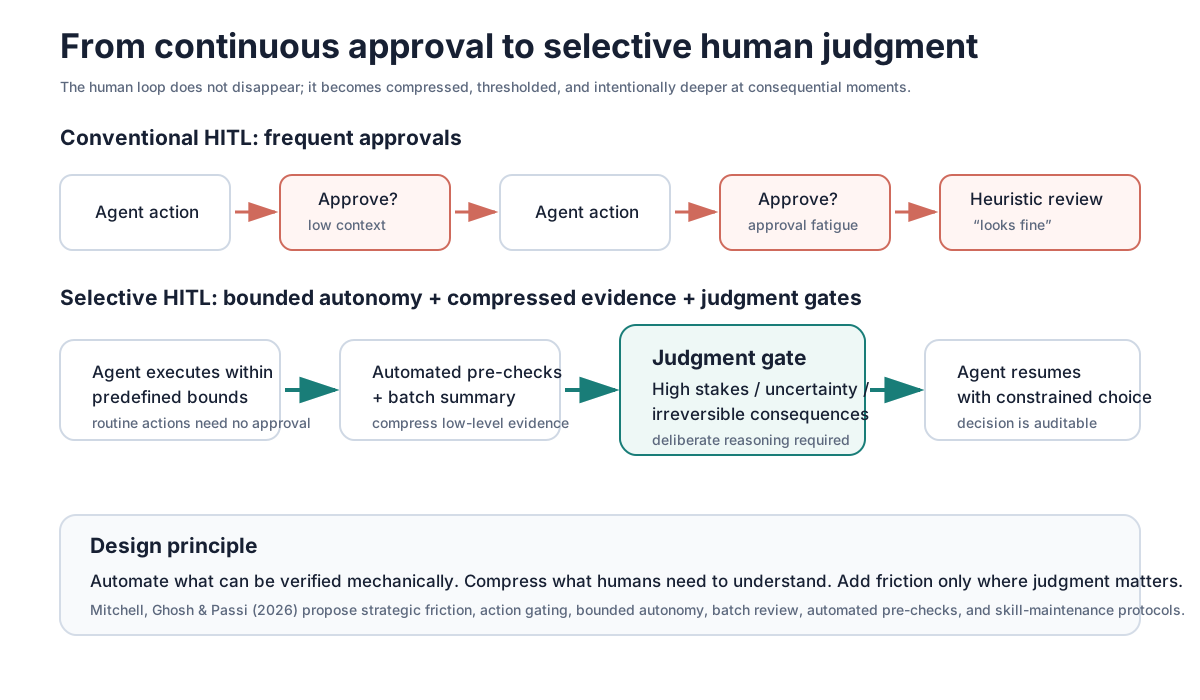
Agentic AI makes continuous human review cognitively weak. Better oversight concentrates scarce attention at consequential judgment gates and trains people to know when to think deeply.
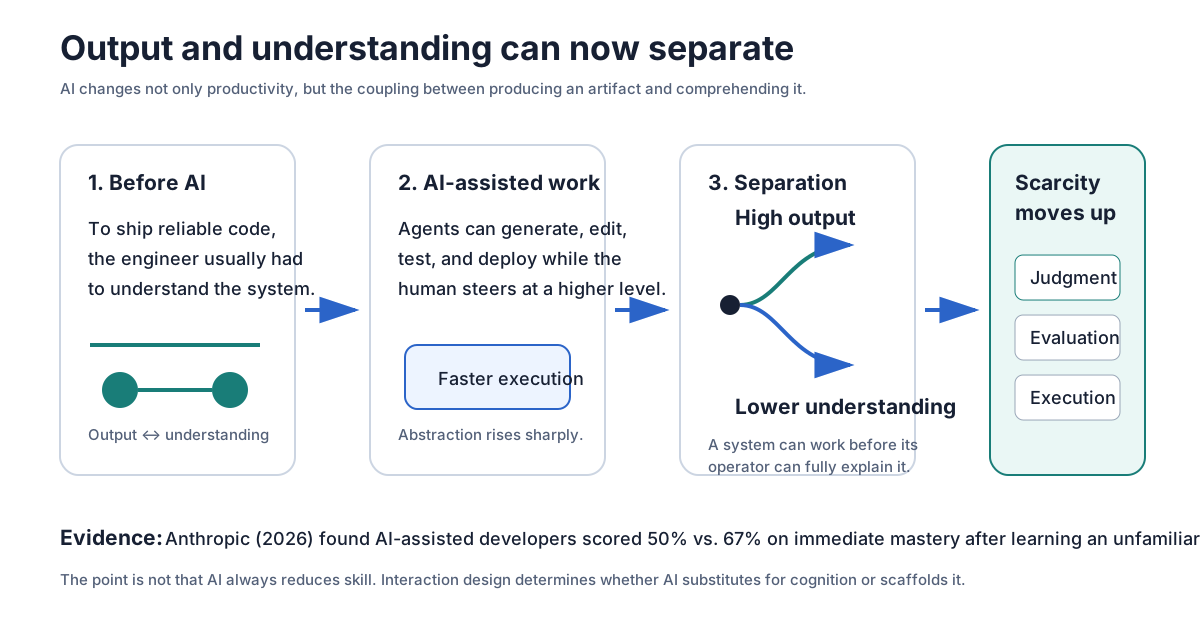
Coding agents are separating output from understanding. The durable human advantage may be less about generating answers than choosing objectives, judging significance, and preserving agency.
Citation-first AI research interface over an approved public corpus, with read-only retrieval, canonical source links, and explicit safety boundaries.
AI social-content generation workflow built around durable job state, asynchronous processing, and staged copy/image generation.
Bilingual mission-support product work presented through selected stakeholder artifacts while keeping the private implementation and sensitive ministry details closed.
FUSE-backed CLI for safely retiring directory symlinks by logging compatibility-path access.
Deterministically split working-tree changes into semantic commit groups before running aicommit.
CLI tools for organizing research projects, sources, and Readwise workflows.
Export ActivityWatch timelines to Obsidian summaries and calendar feeds.
Capability → evidence
Read across each focus area to inspect projects, case studies, and writing. These are evidence types, not proficiency scores; confidential case studies illustrate patterns rather than independently verified deployments.
Status: Not assessed
Release, adoption, and maintenance status have not been verified. A public link alone does not establish maturity.
Next evidence milestone (proposed): Record a dated release and the scope of public evaluation.
Assessment recorded . Categories are not cumulative or percent complete.Status: Not assessed
Release, adoption, and maintenance status have not been verified. A public link alone does not establish maturity.
Next evidence milestone (proposed): Publish a dated, public-safe example of failure recovery.
Assessment recorded . Categories are not cumulative or percent complete.Status: Experimental
The portfolio describes a product prototype; adoption is not claimed.
Next evidence milestone (proposed): Confirm which stakeholder artifacts are approved for public release.
Assessment recorded . Categories are not cumulative or percent complete.Status: Not assessed
Release, adoption, and maintenance status have not been verified. A public link alone does not establish maturity.
Next evidence milestone (proposed): Link a dated release and a reproducible usage example.
Assessment recorded . Categories are not cumulative or percent complete.Status: Not assessed
Release, adoption, and maintenance status have not been verified. A public link alone does not establish maturity.
Next evidence milestone (proposed): Link a dated release and a reproducible usage example.
Assessment recorded . Categories are not cumulative or percent complete.Status: Not assessed
Release, adoption, and maintenance status have not been verified. A public link alone does not establish maturity.
Next evidence milestone (proposed): Link a dated release and a reproducible research workflow.
Assessment recorded . Categories are not cumulative or percent complete.Status: Not assessed
Release, adoption, and maintenance status have not been verified. A public link alone does not establish maturity.
Next evidence milestone (proposed): Link a dated release and a privacy-safe export example.
Assessment recorded . Categories are not cumulative or percent complete.A support request enters orchestration, passes quality checks, and can reach a human expert. Evaluation feeds back into orchestration.
Publication boundary Pattern only, derived from the existing public-safe summary. This is not an Intuit system diagram or a claim about deployed controls.
A question and its available context.
Coordinate retrieval and model calls.
Evaluate the candidate response before proceeding.
Make escalation and responsibility explicit.
Design questions: latency, traceability, safe failure, and ownership of the expert handoff.
Public-summary abstraction reviewed ; not employer approval.Features feed model experimentation and decision support. Monitoring returns observations to model development; people retain operational responsibility.
Publication boundary Pattern only, derived from the existing public-safe summary. No customer data, thresholds, proprietary models, or internal platform topology is shown.
Prepare inputs for model development.
Compare behavior before operational use.
Make model outputs inspectable by risk operations.
Observe behavior and investigate exceptions.
Design questions: false positives, latency, auditability, and escalation of uncertain decisions. Specific controls are not asserted.
Public-summary abstraction reviewed ; not employer approval.Local inputs pass through a narrow command-line interface to inspectable outputs. Inspection informs the next invocation, rather than hiding changes behind a service.
Publication boundary A common design pattern across separate tools, not a claim that these repositories form one integrated system.
Research state, activity records, or filesystem access.
A narrow interface for one workflow.
Review logs, project files, or calendar exports.
Design questions: repeatability, privacy of local data, and recovery from failed operations. Guarantees vary by tool.
Public-summary abstraction reviewed ; not employer approval.13+ years across production ML, GenAI, cloud platforms, and distributed systems. My work spans engineering, technical leadership, and responsible technology in Christian ministry and other mission-driven contexts.
Production ML, agentic systems, evaluation, guardrails, platforms, and the leadership required to make them dependable.
Theology, Christian formation, mission, and the human consequences of increasingly capable technology.
Engineering alongside leadership, education, recognition, and mission. Exact career dates are not available in the published CV; undated entries are shown without a time scale or implied alignment.
Senior Lead Machine Learning Engineer — enterprise LLM evaluation, agentic workflows, guardrails, and platform enablement.
Author-reported CV source notesSenior Machine Learning Engineer — production GenAI orchestration, support automation, ML systems, and mentoring.
Author-reported CV source notesMember of Technical Staff — automation, release infrastructure, distributed systems testing, and operational tooling.
Author-reported CV source notesDeveloping engineers and enabling teams through platform quality and cross-team architecture.
Author-reported CV source notesM.Div. candidate at Southwestern Baptist Theological Seminary. The CV lists expected 2026; completion is not verified.
Author-reported CV source notesThe CV reports three U.S. patents and a Gloo.AI Best Concept Award. Identifiers and award dates are not published here.
Author-reported CV source notesHanuri Missions: bilingual product communication with an explicit privacy boundary.
Hanuri Missions portfolio note